

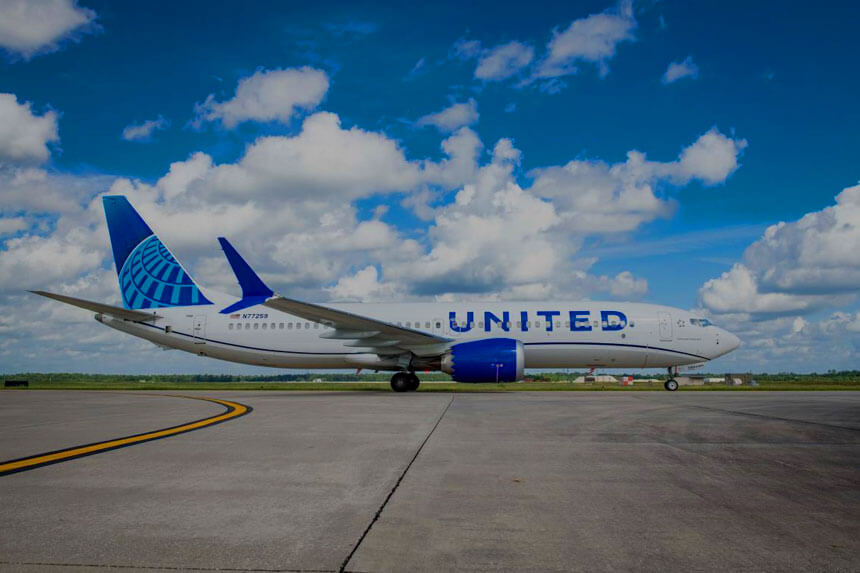
United Airlines Flight UA770 emergency diversion occurred on May 27, 2025, when the Barcelona to Chicago flight declared an emergency mid-Atlantic and safely landed at London Heathrow Airport. The Boeing 787-9 Dreamliner carrying 257 passengers and 12 crew members landed safely on runway 27R after pilots detected a cabin pressurization emergency. This aviation incident showcases how modern commercial aviation safety systems work when unexpected problems arise during flight.
Confirmed Flight Details and Timeline
Flight UA770 departed Barcelona El Prat Airport at approximately 2:30 PM CEST on May 27, 2025, bound for Chicago O’Hare International Airport. The aircraft involved was a Boeing 787-9 Dreamliner with registration number N26902, operating a standard transatlantic route covering nearly 4,500 miles.
About 90 minutes into the flight, while cruising at 37,000 feet over European airspace, pilots noticed cabin pressure fluctuations with the cabin pressure systems. The crew immediately began following emergency procedures and contacted air traffic control. The pilots squawked code 7700, the international transponder code for general emergency, and decided to divert to London Heathrow Airport. The flight landed safely at 4:55 PM BST on runway 27R and taxied to gate B44.
Technical Cause: Pressurization Alert Explained
The pressurization system maintains safe air pressure inside the cabin at high altitudes, and even a minor malfunction can become serious if not addressed promptly. At cruising altitude, the air outside is too thin for humans to breathe normally.
Modern aircraft like the Boeing 787-9 have multiple sensors that constantly monitor cabin pressure through the Airplane Health Management system, which monitors over 280,000 parameters in real-time. While official investigations are ongoing, preliminary findings point to a pressurization system malfunction—likely involving a pressure outflow valve or associated sensor. Importantly, while some reports mentioned oxygen masks dropping, there were no dramatic scenes, suggesting the issue was addressed before reaching critical levels.
Crew Response and Flight Diversion Protocol
When pilots squawk 7700, it signals a general emergency and gives the aircraft top priority with air traffic control, instantly visible to all radar controllers and triggering emergency response protocols. This emergency declaration doesn’t mean catastrophe is happening—rather, the term “diversion” derives from the Latin “divertere,” meaning “to turn aside” as a precautionary measure.
The captain and first officer quickly followed SOPs (Standard Operating Procedures), consulted checklists, and contacted air traffic control following standard emergency protocols. They chose London Heathrow because it’s one of the most emergency-prepared airports in Europe with advanced systems like the Instrument Landing System (ILS). This emergency rerouting balanced proximity with the airport’s ability to handle wide-body aircraft emergencies.
Passenger Experience and Onboard Management
For passengers, everything changed in just a few minutes—one moment they were relaxed, the next the plane was turning off course, but the crew handled everything very professionally. Flight attendants moved through the cabin reassuring passengers and explaining the situation.
Passengers reported that the cabin atmosphere remained calm thanks to the cabin crew’s reassuring presence and clear communication, with no panic reported. The professional crew response and prompt communication helped keep anxiety at bay, with passengers updated through calm instructions. This focus on passenger welfare demonstrated how crew training prepares staff for these exact situations.
Ground Response and Post-Landing Handling
Once the problem was identified, real-time aircraft health monitoring started sending vital information to European air traffic control and United’s operations center, with EUROCONTROL seamlessly coordinating UA770’s safe navigation across Spanish, French, and UK airspace. Emergency vehicles stood by on the runway as a precaution.
Once on the ground, United Airlines provided affected passengers with hotel stays, meal vouchers, and rebooking assistance, with some also receiving travel credits as compensation. Upon landing, passengers were greeted by emergency responders and United Airlines agents who arranged overnight accommodations and rebookings. The airline’s passenger support services exemplified industry standards for handling air travel disruption.
Comparison to Similar Incidents and Aviation Safety Systems
The UA770 incident added to several United Airlines emergency diversions in 2025 due to technical or medical issues, though these incidents occur only once per 1,500 flights. This frequency demonstrates that while diversions grab headlines, they’re actually proof that safety systems work properly.
According to IATA data, only 0.04% of global flights are diverted for emergency reasons, with pressurization issues accounting for fewer than 5% of these cases. These numbers show that what appeared as a dramatic flight emergency was actually a routine application of safety protocols—the opposite of routine flight completion, but evidence of effective precautionary measures.
Key Takeaways: What Readers Should Remember
The United Airlines Flight UA770 emergency diversion was more than just a precaution—it was an affirmation of how safety-first culture, advanced aircraft systems, and well-trained crews collaborate to protect lives. The incident proves that commercial aviation remains one of the safest forms of travel.
The most important lessons from this unscheduled diversion include understanding that diversions are preventive steps, not panic moves. Major airports are chosen for their ability to handle emergencies, and this safe landing demonstrates the effectiveness of international aviation safety protocols. For travelers, this incident shows that trusting the process and staying calm during unexpected events is the best approach. Modern aircraft have multiple backup systems, and crews train extensively for these exact situations, turning potential crises into successful examples of aviation professionalism.
Note: This article focuses on the well-documented May 27, 2025 incident involving Boeing 787-9 Dreamliner N26902. The aircraft was grounded for detailed inspection to determine the exact cause of the technical problem, with investigations by both EASA and FAA ongoing.
