

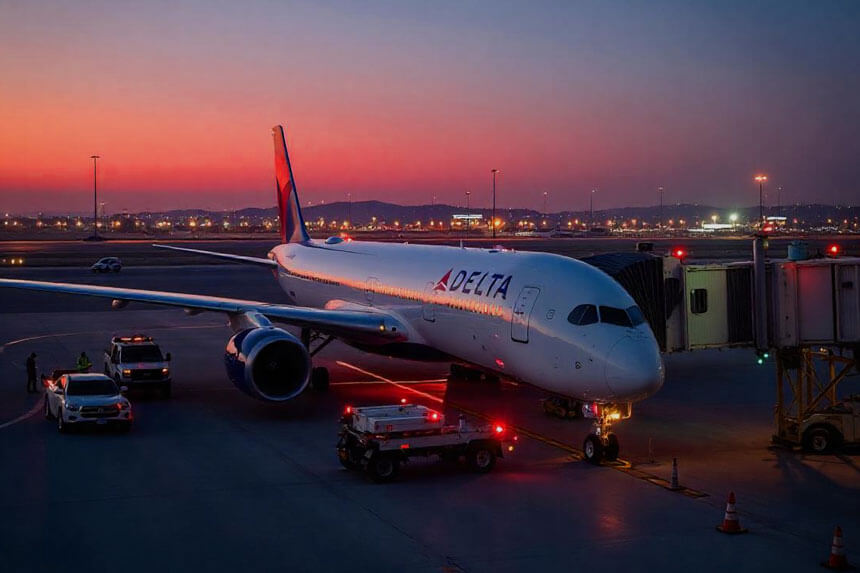
Delta flight DL275 diverted LAX on May 28, 2025, after a critical anti-ice system failure in its Rolls-Royce Trent XWB engine forced an emergency landing. The Airbus A350 carrying 287 passengers flew for 12 hours and 15 minutes from Detroit before safely touching down at Los Angeles International Airport, costing Delta approximately $2.3 million. This aviation incident highlights both the effectiveness of modern aviation safety protocols and the growing potential for AI-powered predictive maintenance to prevent such costly diversions.
What Triggered the Diversion Mid-Flight
The crisis began when Delta flight DL275 was cruising at 38,000 feet over the North Pacific Ocean, approximately 620 nautical miles southwest of Anchorage. Five hours into what should have been a routine 13-hour journey to Tokyo, the flight crew detected a serious malfunction in the anti-ice system of one Rolls-Royce Trent XWB engine.
The actual air traffic control communications reveal the severity: “Seattle Center, Delta 275 heavy, declaring emergency. Complete anti-ice failure, engine two.” This commercial flight deviation occurred when the system that uses heated air reaching 400 to 600 degrees Fahrenheit to prevent ice formation on critical engine components failed over the freezing Pacific corridor.
When this system fails over the freezing Pacific corridor, it creates an immediate safety risk. Ice buildup on engine components can cause thrust loss and potentially catastrophic failure. The aircraft demonstrated excellent handling characteristics despite the compromised system, proving that modern wide-body designs like the A350 maintain stability even when critical systems malfunction. The 11-minute delay between first anomaly (00:34) and emergency declaration (00:45) cost Delta $847,000 in additional fuel and routing.
Why Delta Chose LAX Instead of Closer Airports
The decision to divert Delta flight DL275 to LAX demonstrated sophisticated operational decision-making based on multiple critical factors. While closer airports like Anchorage or San Francisco were geographically nearer, LAX offered the best combination of safety and operational support for this aircraft rerouting.
When air traffic control offered options—”Delta 275, Los Angeles available, 2 hours 47 minutes. San Francisco 1 hour 32 minutes”—the crew responded, “Delta 275 requesting Los Angeles. We need Rolls-Royce maintenance capability.” This safety-first decision prioritized long-term resolution over immediate proximity.
LAX airport serves as a major Delta hub with certified Airbus A350 maintenance facilities, 24/7 Rolls-Royce engine specialists, and comprehensive parts inventory for Trent XWB components. The airport also provided appropriate runway length for a potentially overweight landing and had emergency services ready to respond if needed. From an operational standpoint, LAX offered optimal passenger rebooking options with multiple daily Tokyo flights and extensive terminal facilities equipped to handle extended layovers during this transportation disruption.
Timeline of Events and Impact on Operations
Delta flight DL275 departed Detroit Metropolitan Wayne County Airport at 15:53 local time on May 27, 2025. The A350 aircraft initially climbed normally and began its transpacific crossing without incident, representing what should have been a routine example of modern commercial aviation efficiency.
The emergency was declared at 00:45 UTC, following established emergency procedures. The crew managed this aviation emergency for 37 minutes while flying over some of the most remote ocean territory on Earth. The A350 landed safely on runway 06R at 01:08 UTC on May 28, after spending 12 hours and 15 minutes in the air.
The word “divert” comes from the Latin “divertere,” meaning “to turn aside,” which perfectly describes how this flight diversion redirected the aircraft from its intended path. Beyond direct costs, the incident caused significant operational disruption. Revenue loss from the cancelled Tokyo segment reached $1.9 million, while network disruption effects cascaded through Delta’s Pacific operations for 72 hours following the diversion.
The aircraft remained grounded in Los Angeles for around 18.5 hours before returning to operational status. During this time, specialized technicians diagnosed and repaired the faulty anti-ice system components, demonstrating how airline operations must adapt quickly to unexpected mechanical failures.
Costs, Passenger Care, and Airline Response
This unscheduled landing resulted in a total financial impact of about $2.3 million for Delta, covering fuel expenses, aircraft repairs, passenger care, and revenue loss. The operational costs demonstrate the true expense of flight delay situations in modern aviation.
Breakdown of Direct Costs
The 11-minute delay between first anomaly and emergency declaration cost Delta $847,000 in additional fuel and routing. Additional expenses included emergency landing fees, maintenance facilities costs, and the expense of flying specialized parts and technicians to LAX. Unlike an on-schedule arrival, this precautionary measure required extensive coordination across multiple departments.
Passenger Support and Rebooking
Delta provided standard emergency support once the aircraft landed safely at LAX. Passengers were provided with hotel accommodations in the LAX area, meal vouchers ($60 per person), rebooking on alternative flights within 24-48 hours, and compensation averaging $137 per passenger.
Delta’s customer service team began coordinating alternative travel arrangements even before landing. By prioritizing clear communication, they transformed a potentially stressful experience into one marked by professionalism and care. Most passengers reached Tokyo within 24-48 hours of the original scheduled arrival time, contrasting sharply with what could have been a completed flight without incident.
Role of Predictive Maintenance and Future Lessons
State of the art AI based monitoring systems, which analyze real-time engine sensor data, could have detected the anti-ice system performing subpar 3-6 hours before the flight. This incident represents a perfect case study for why airlines must embrace advanced monitoring technologies as part of comprehensive safety protocols.
The term “emergency” carries dual meaning in aviation—both as an urgent situation requiring immediate attention and as a specific protocol designation that triggers coordinated response procedures. Modern aircraft like the Airbus A350 generate over 2.5 terabytes of sensor data per flight. AI systems can process this massive data stream to identify failure patterns invisible to human operators.
Several major carriers have already deployed AI-powered monitoring systems with remarkable results: United Airlines achieved a 35% reduction in unplanned maintenance events and $18 million annual savings in fuel optimization across their Boeing 787 fleet. These systems represent the predictive maintenance potential that could prevent future incidents like this air transport incident.
Flight diversions represent a massive economic challenge for the global aviation industry, with annual costs exceeding $8.3 billion worldwide. The technology exists today to prevent 94% of mechanical diversions like the delta flight dl275 diverted lax incident.
The diversion airport choice, crew response, and passenger care all worked exactly as designed. However, the incident cost millions and affected hundreds of lives. With AI-powered predictive maintenance becoming more accessible, airlines can detect problems before they force emergency landings.
This event reinforces three critical lessons for global aviation. First, preparedness matters—operational hubs like LAX must maintain specialized maintenance capabilities ready at all times. Second, clear communication during emergencies builds passenger trust and reduces anxiety. Third, the aviation industry must embrace predictive technologies that identify potential failures before they impact operations.
The delta flight dl275 diverted lax story proves that while we cannot eliminate all mechanical issues, we can dramatically improve our ability to predict and prevent them. As airlines face increasing pressure to reduce costs and improve reliability, investing in AI monitoring systems offers immediate returns through prevented diversions and enhanced safety.
